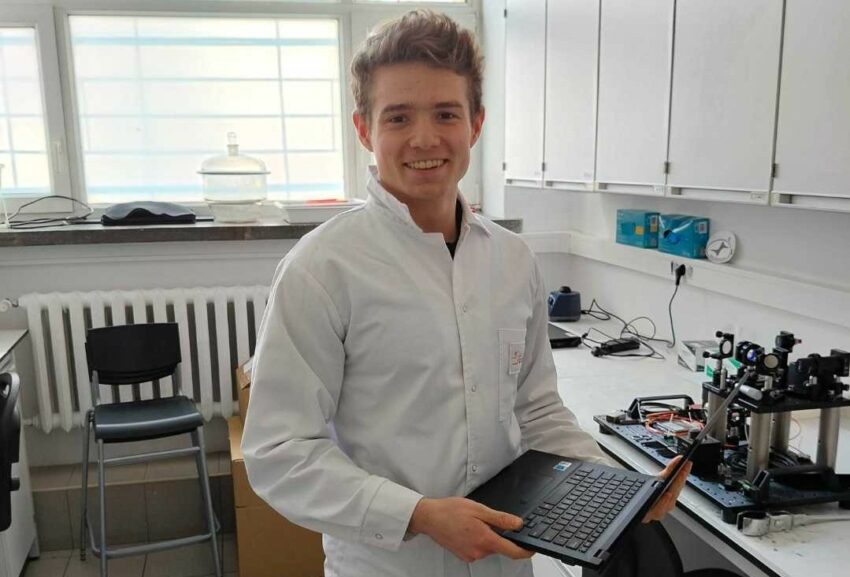
From 17 February, Sensor Arrays got a new group member, Damian Gierek. Damian is a master’s student at the Department of Physics, University of Warsaw, where he specialises in computer modelling of physical phenomena. His academic background combines solid training in physics with a strong computational focus, particularly in the application of modern data‑driven methods to complex measurement problems. His research at UW involves extracting trajectories of moving objects from video recordings using convolutional neural networks. This project has deepened his expertise in machine learning, data processing, and neural‑network architectures.
Within Sensor Arrays Sonata BIS project, Damian will work closely with Steven on the topic “Machine Learning for Electrochemical Date Rape Drug (DRD) Detection: Theoretical Extensions and Proof‑of‑Concept Substance Discrimination.” The primary goal of this thesis is to assess whether machine‑learning techniques can reliably support the electrochemical discrimination of different substances in a flow‑based measurement system. Achieving this goal requires both an improved theoretical understanding of cyclic voltammetry (CV) peak behavior and the creation of a comprehensive dataset comprising simulated and experimental voltammograms.
This research is motivated by the limitations of the classical Randles–Ševčík equation, which is commonly used to interpret CV peak currents but relies on idealized assumptions that are seldom satisfied under practical experimental conditions. Developing refined theoretical models may yield more physically meaningful features that can be exploited by machine‑learning algorithms. In parallel, demonstrating that neural networks can successfully distinguish substances based on their CV signatures would provide strong support for the development of rapid, low‑cost electrochemical sensing technologies. Such platforms could ultimately be adapted for real‑world applications, including the detection of harmful or illicit substances.
This research is supported by NCN Sonata BIS project 2023/50/E/ST4/00639.